Simulation
Magnetic Memory
PASS — B5_magnetic_memory
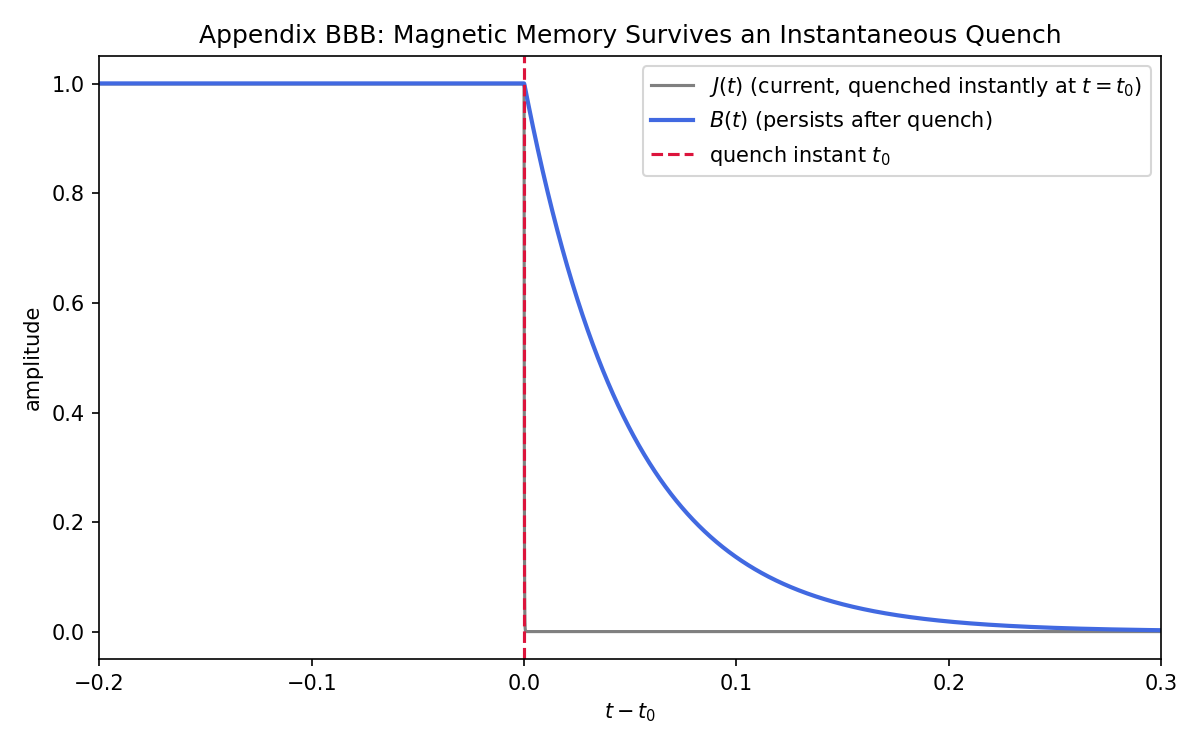
What this does prove
After an ultrafast quench sets the current J≈0, the magnetic field B does not vanish instantaneously — it persists and decays on a finite, kernel-governed memory timescale, matching the fitted decay constant to the kernel's own τ.
What this does not prove
That this specific causal memory-kernel mechanism is how real electromagnetic memory effects work — this checks internal consistency of the appendix's own stated kernel, not an independent physical mechanism.
Claim B5_magnetic_memory — from Appendix BBB — Historical Proof Experiment: Magnetic Memory Beyond Instantaneous Carriers
After an ultrafast quench sets J~0, B does not vanish immediately; it persists for a finite, kernel-governed memory time.
Measured
tau_mem_kernel=0.05, quench_width=0.0001, B_at_quench_instant=1.0010003333333057, B_shortly_after_quench=0.9725494372018524, J_is_zero_at_quench=true, B_survives_quench=true, dt_mem_measured=0.05010000000000003, fitted_decay_tau=0.050000004081833666, fitted_tau_matches_kernel=true, memory_finite_and_nonzero=true, prediction_confirmed=true
Expected
prediction_confirmed=true
Source:
theory_lab/group_b_temporal_closure/magnetic_memory.py in UNIFIED_THEORY_LAB. See how to run this yourself.