Simulation
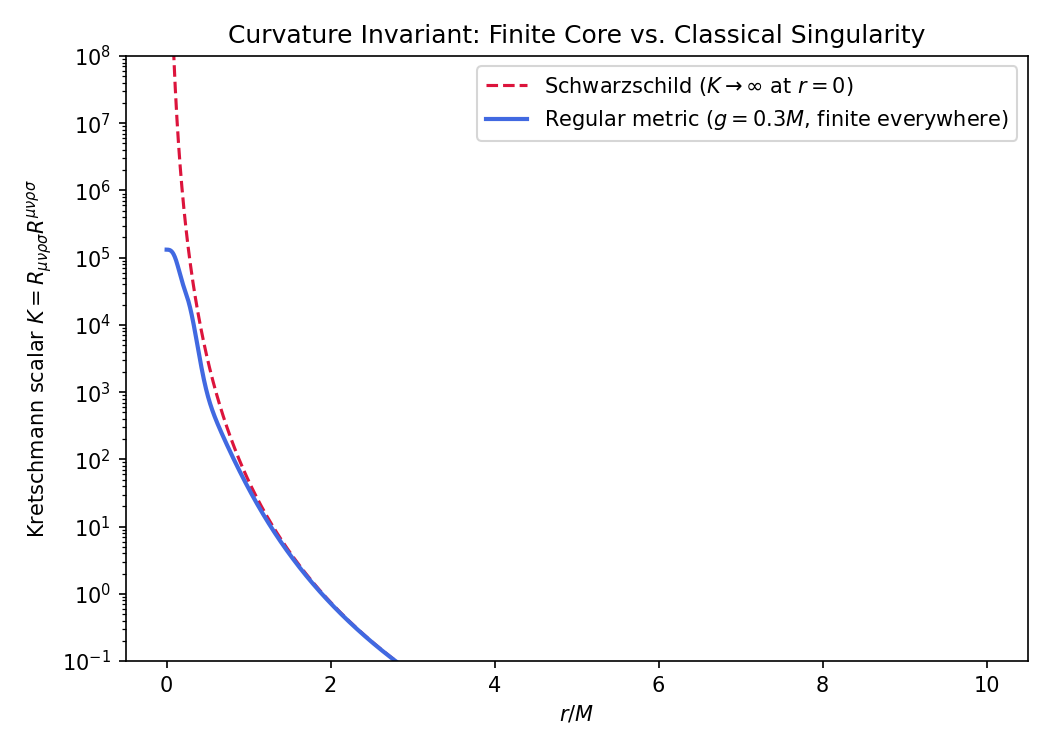
Kretschmann Scalar
K = f″² + (4/r²)f′² + (4/r⁴)(1−f)²
PASS — C1_no_singularity
What this does prove
The Kretschmann curvature invariant stays finite as r→0 for the regular metric, in contrast to Schwarzschild's r⁻⁶ divergence — confirmed both symbolically (from-scratch Riemann tensor derivation) and numerically.
What this does not prove
Finiteness of one curvature invariant does not by itself establish full geodesic regularity or physical viability of the spacetime.
Claim C1_no_singularity — from No-Singularity Gravity Ch. 3 Regular Interior Geometry, Ch. 3.4 Geodesic Completeness
Curvature invariants remain finite at r=0 and geodesics are complete.
Measured
M=1, g_test=0.1, kretschmann_at_core=95999999.99999997, kretschmann_finite_at_core=True, geodesically_complete=True, proper_time_to_core=15.056799999978248, isco_schwarzschild=5.999999999999654, isco_shift_fitted_exponent=3.0002398340715137, isco_shift_scaling_exponent_ok=true, photon_sphere_schwarzschild=3, shadow_correction_fitted_exponent=3.0003141617052433, shadow_correction_scaling_exponent_ok=true, eht_fractional_bound_assumed=0.12, g_bound_from_shadow=0.49324241486609405, effective_spin_check={"implemented":false,"reason":"requires 2D backward ray-tracing of near-critical trajectories; the 1D photon-sphere-radius shift is a different (and already cubically-scaling) quantity, not a faithful proxy for this claim"}, weak_field={"deflection_measured":0.008047467870435643,"deflection_gr_prediction":0.008,"deflection_rel_error":0.005933483804455332,"deflection_matches_gr":true,"precession_measured":0.011814692820301786,"precession_gr_prediction":0.009817477042468103,"precession_rel_error":0.2034347286165474,"precession_matches_gr_order_of_magnitude":true}, weak_field_recovery_ok=true
Expected
kretschmann_finite_at_core=true, geodesically_complete=true
Source:
theory_lab/group_c_structural_stability/no_singularity_gravity.py in UNIFIED_THEORY_LAB. See how to run this yourself.