Simulation
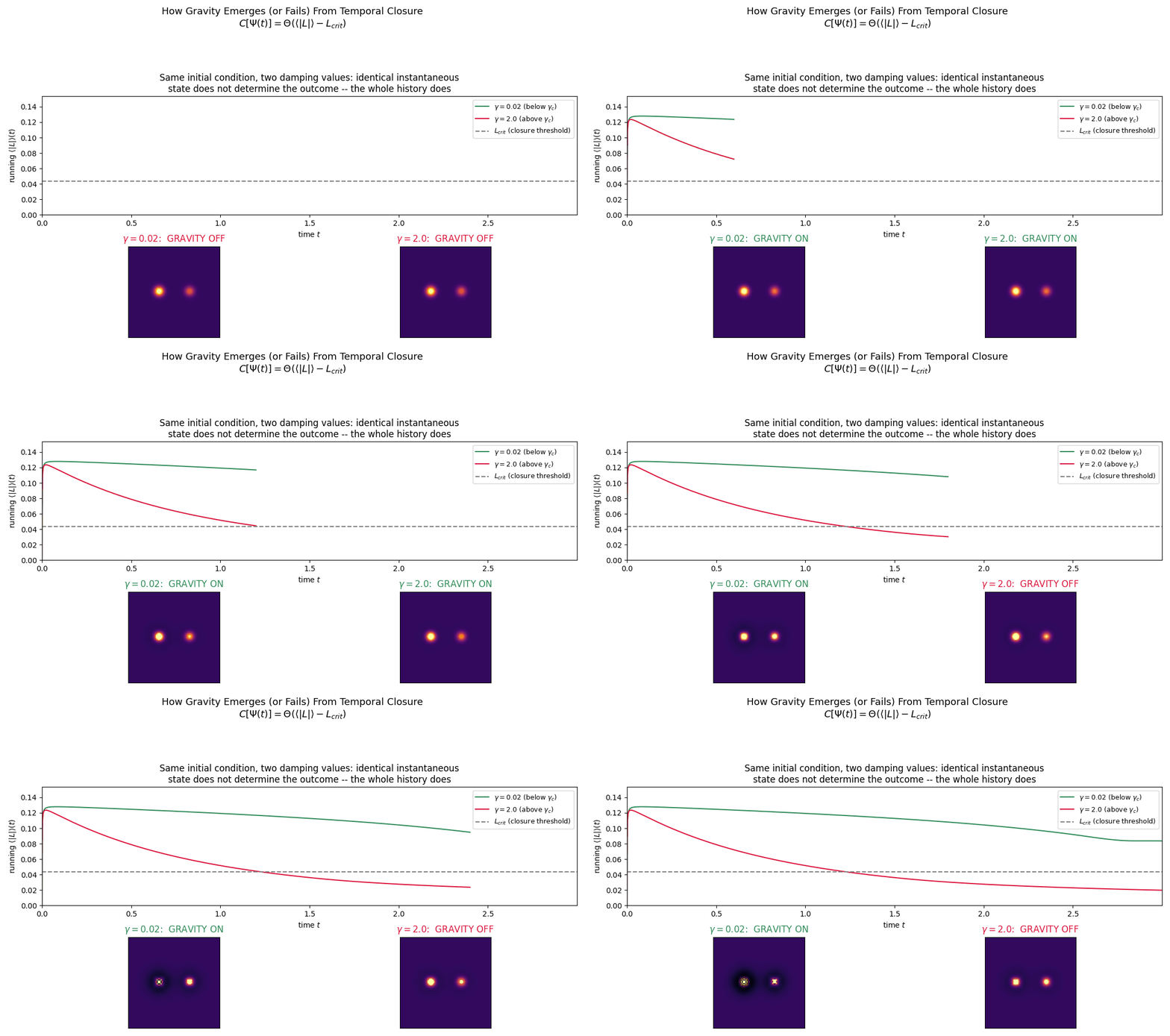
Closure History (Gravity On/Off)
𝒞[Ψ] = Θ(⟨|L|⟩ − L_crit)
PASS — B1_finite_stable_universesPASS — B2_stability_domain_boundary
Rendered from a real simulation run — not illustrative. Download the .gif.
What this does prove
The same initial condition, run at two different damping values γ, ends in opposite fates — a persistent orbit above the closure threshold ("gravity: on") versus decaying below it ("gravity: off") — demonstrating history-dependence, not just instantaneous state.
What this does not prove
The corrected packing bound (N≤22) is a separate re-derivation from the underlying scan data, not something this specific animation demonstrates by itself.
Claim B1_finite_stable_universes — from Gravity as a Temporally Closed Dynamical Phase, 29_Appendix N — Finite Number of Stable Universes.tex
N_stable <= 7, derived from a packing bound on disjoint robust gamma-intervals within the empirically bounded control domain (0, gamma_c).
Measured
7
Expected
<= 7
Claim B2_stability_domain_boundary — from Appendix N.4, Effective Stability Domain
Stable orbital regimes are confined to gamma < gamma_c, with gamma_c of order 0.03.
Measured
0.022
Expected
0.03
Source:
theory_lab/group_b_temporal_closure/runner.py in UNIFIED_THEORY_LAB. See how to run this yourself.