Simulation
Emergent Causality
PASS — B4_emergent_causality
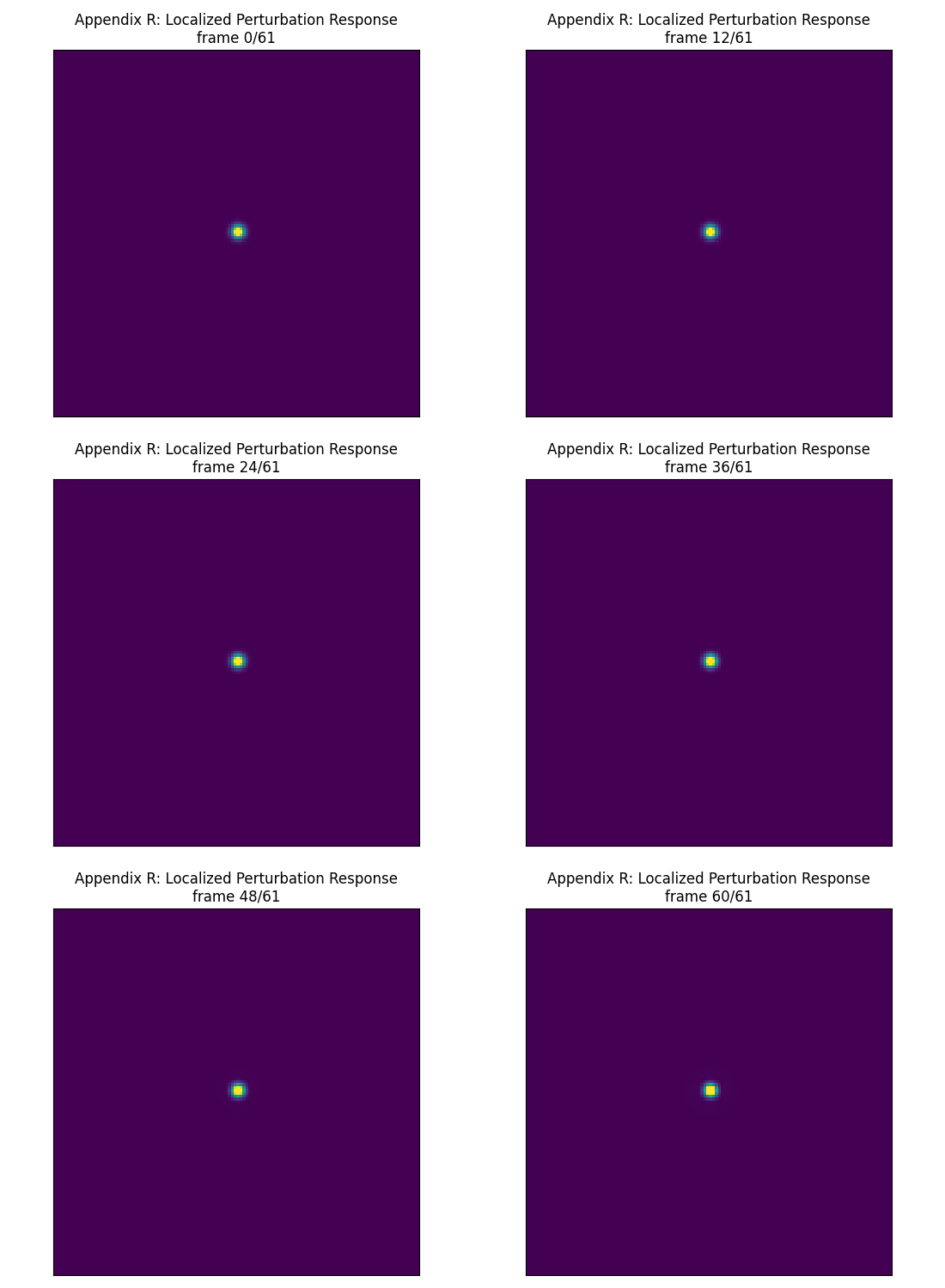
Rendered from a real simulation run — not illustrative. Download the .gif.
What this does prove
A localized perturbation produces a detectable response at increasing distance only after a time proportional to that distance — i.e. a finite, horizon-robust maximum signal speed emerges from dissipation and coherence loss, using the manuscript's own operational definition (not a claimed closed-form formula).
What this does not prove
Lorentz invariance of the emergent dynamics — that is a separate, much stronger claim ("Theorem S.1") that the manuscript itself leaves without a proof; see Open Review.
Claim B4_emergent_causality — from Appendices R, S, V, KKK, LLL, MMM, NNN (causality/Lorentz-invariance-from-closure cluster)
A finite, horizon-invariant maximum signal speed emerges from dissipation and coherence loss.
Measured
gamma=0.03, mu=0.2, chi=1, measured_speed_T=10.47672331047794, measured_speed_2T=8.223455784058782, fit_r2_T=0.9880859672194505, fit_r2_2T=0.9723208532676499, speed_is_finite=true, horizon_invariant=true, c_eff_dimensional_estimate=0.15, order_of_magnitude_consistent=false, causality_check_ok=true, note=c_eff is defined operationally in Appendix R (Definition R.1), not by a closed-form formula, so 'order_of_magnitude_consistent' against the dimensional estimate gamma/mu is a loose cross-check, not a precision test.
Expected
speed_is_finite=true, horizon_invariant=true
Source:
theory_lab/group_b_temporal_closure/emergent_causality.py in UNIFIED_THEORY_LAB. See how to run this yourself.