Simulation
Born Rule Convergence
P(outcome i) → |cᵢ|² as N→∞
PASS — C4_born_rule_measure_concentration
What this does prove
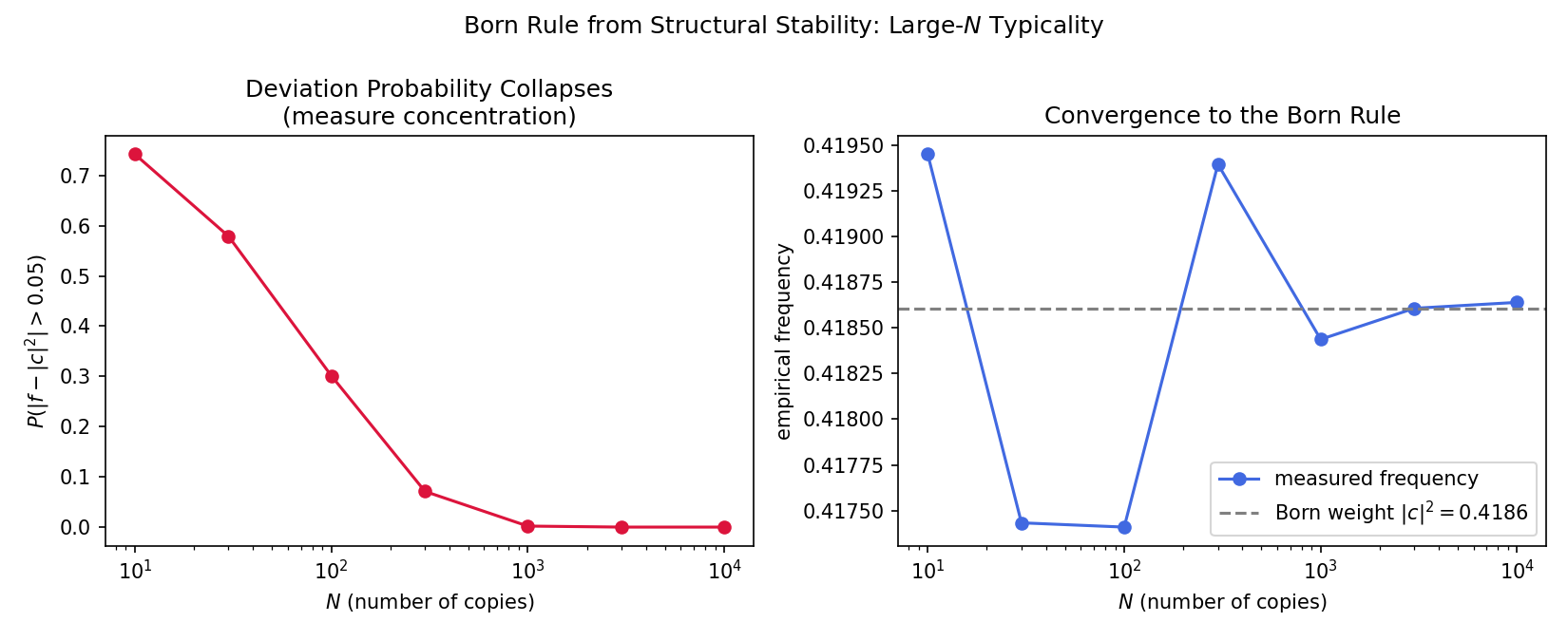
Empirical outcome frequencies concentrate on the squared-norm (Born) weights as the number of trials N grows, with exponentially suppressed probability of atypical deviation — a large-N typicality argument, verified numerically.
What this does not prove
That squared-norm weighting is the unique measure with this property from first principles alone — see the separate algebraic derivation in Lemmas A.1–A.2, which this simulation does not depend on.
Claim C4_born_rule_measure_concentration — from BornRule Ch. 5 Large-N Limit and Measure Concentration
Empirical frequencies concentrate on |c_i|^2 as N grows, with exponentially suppressed atypical-branch measure.
Measured
probs=[0.41860465116279066,0.2906976744186048,0.18604651162790703,0.10465116279069767], tracked_outcome=0, eps=0.05, N_values=[10,30,100,300,1000,3000,10000], deviation_probability_by_N=[0.7425,0.579,0.3015,0.071,0.002,0,0], mean_frequency_by_N=[0.41945,0.4174333333333333,0.41740999999999995,0.41939499999999996,0.418437,0.41860683333333326,0.41863924999999996], fitted_alpha=2.3357103276903075, measure_concentration_confirmed=true, converged_to_born_weights=true, born_weight_target=0.41860465116279066, empirical_frequency_at_largest_N=0.41863924999999996
Expected
measure_concentration_confirmed=true, converged_to_born_weights=true
Source:
theory_lab/group_c_structural_stability/born_rule_measure_concentration.py in UNIFIED_THEORY_LAB. See how to run this yourself.